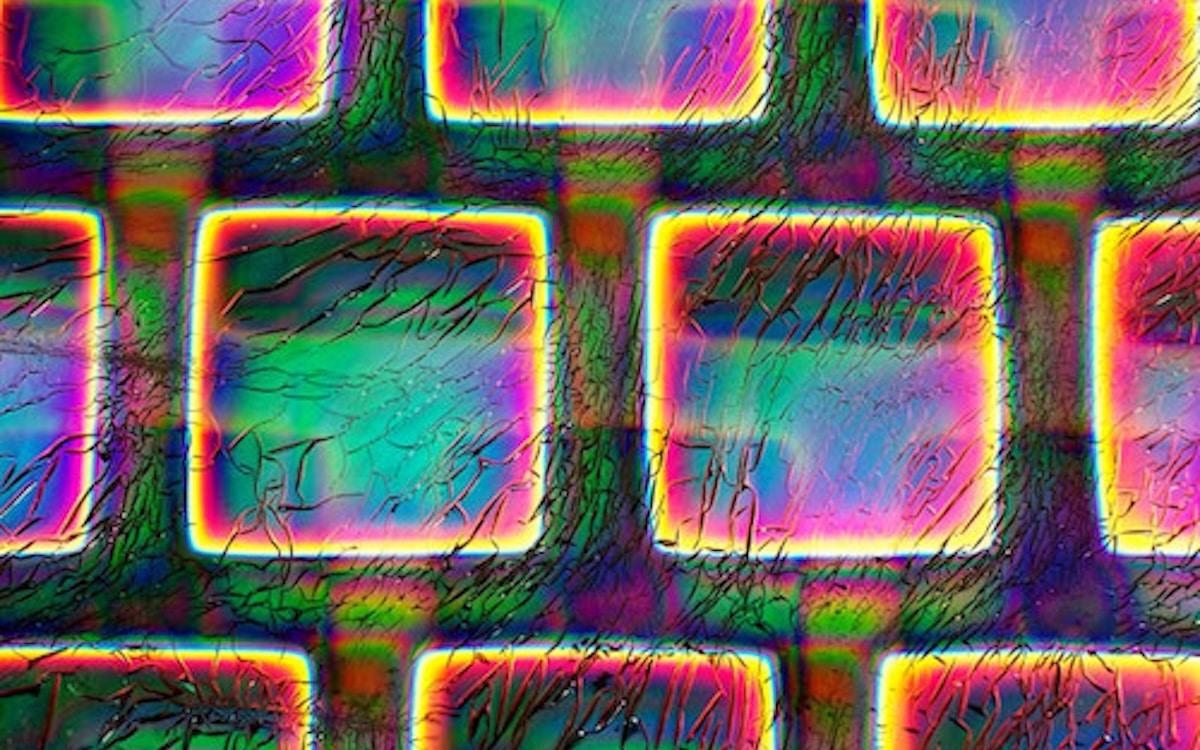
The Secret Beauty of Dichroic Glass
At first glance, one might think that Dichroic glass is just pretty glass.
On it’s surface, dichroic glass displays multiple colors depending on the lighting and the angle that it’s viewed from. But at its core, it’s the result of a sophisticated science that started around 2000 years ago.
Today’s dichroic glass is used in art, architecture, and loads of other applications, AND it’s one of our favorite materials to work with here at The Purple Galaxy.
In this article, I’ll talk about the history as well as the science that makes all those colors possible; from ancient artifacts, to NASA, to its use in art today – all quite colorful stories themselves.
Let’s start at the beginning…
The Greeks
In Greek, the word dichroic means “two-colored”. The earliest version of this glass was created over 2000 years ago when artisans would add trace amounts of silver and gold to a large quantity of melted glass.
When it cooled, the glass would come alive emitting different colors depending on the direction of the light source.
Their technology was an early form of “nanotechnology” (the science of manipulating matter at the nano scale 1 to 100 nanometers). This achievement remains impressive even today.
The Lycurgus Cup: An Ancient Marvel
The oldest example of this type of glasswork is housed in London’s British Museum.
It is known as the Lycurgus Cup and was made around 2000 years ago (4th century AD – aka the 300’s) by craftsmen in the Roman Empire.
This cup was carved from one solid mass of silver and gold infused glass. It was decorated with silver embellishments on both the rim and the stem of the cup.
It is most famous for appearing green under normal daylight and then turning red when lit from behind.
There are more pictures of it on the British Museum’s website.
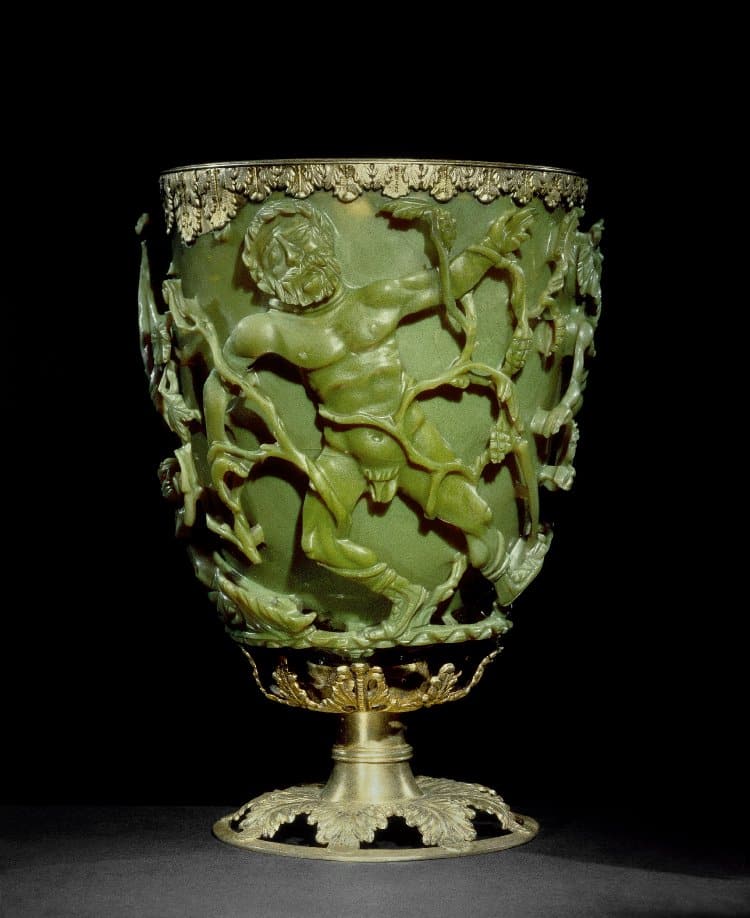
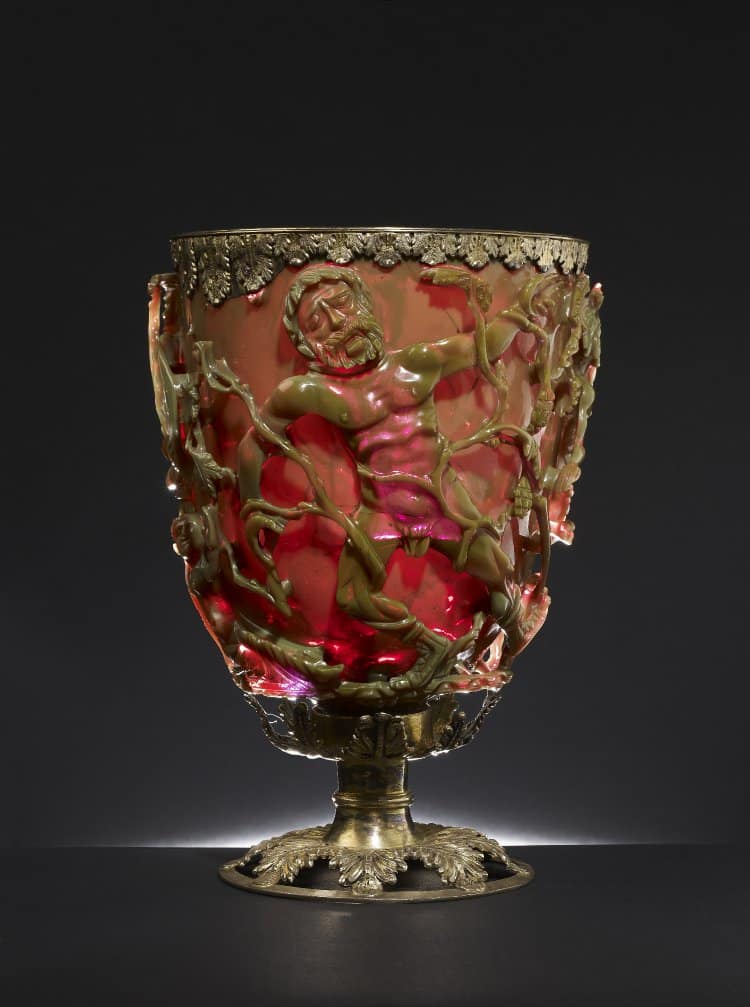
Photos: Wikimedia Commons
Quick Note About the Carvings on the Cup:
There’s an entire story carved around the cup representing the death of King Lycurgus – hence the name “The Lycurgus Cup”.
As the story goes, King Lycurgus banned the cult of Dionysus and all of his naughty winemaking ways – a kind of wine prohibition if you will.
To retaliate for the ban on making or drinking wine, the Greek God Dionysus drove King Lycurgus insane. After the King’s death, the ban was lifted and the people were free to cultivate grapes and enjoy their wine again. I bet the parties were wild! So, that’s a quick take on the story carved around the cup.
ANYway…
1887: Dichroic Glass Technology Moves Forward
The next step towards the high-tech version of this color-shifting glass came about in 1887 by a gentleman named R. Nahrwold who was a researcher based in Germany.
Confirmed by scientific literature of that time, he demonstrated that when a platinum wire/filament was heated in a vacuum, it would “sublime” (turn from a solid into a gas). This “platinum” gas floated around the vessel and condensed, leaving a thin film on the glass walls of that vessel.
Later on, his contemporary August Kundt would use this “measurable” thin film to study the optical properties of these metals.
1950-1960: NASA and Dichroic Glass.
It wasn’t until the 1950’s and 1960’s that scientists at NASA developed a technology that involved vaporizing quartz and metal oxides like titanium, magnesium or aluminum with an electron beam.
The resulting vapor condensed micro-thin layers of these metals onto a glass surface in 30 to 50 microscopic layers. These layers are thinner than a human hair (about 30 millionths of an inch).
NASA’s original goal was for survival and rightly so.
For example, the iconic “gold” look of NASA astronaut’s helmets (see photo below) are indeed coated with a layer of 24-karat gold to protect their eyes from the unfiltered blinding glare of the sun.
The gold-mirror on the outside reflects 99% of infrared (heat) away from the astronaut’s face. This keeps their faces from being fried by the unfiltered sun’s rays while in space.
Because the film is so thin it’s actually transparent. The astronaut looking out sees everything with a cool, blue-green tint… serious sunglasses!

Photo: NASA Hubble Space Telescope – Wikimedia Commons
NASA’s “Cold Mirror” vs. “Hot Mirror”
Gold was also specifically chosen by NASA for the Apollo and Space Shuttle missions, again because of its incredible infrared (heat) reflection.
Cold Mirrors: These use coatings that reflect visible light but allow Infrared (heat) to pass through the back. This was used to keep camera equipment from overheating.
Hot Mirrors: These do the opposite—reflecting Infrared heat away while letting visible light through. This is what keeps an astronaut’s face cool while staring directly at the sun.
It was also used on Satellite Mirrors to reflect harmful solar radiation and cosmic rays while letting visible light to pass through for sensors.
Versions of it have since been used for many additional applications such as optical instruments, lasers, fiber communication, optical recording and storage heads, photoelectric converters, and so much more.
1970s: Dichroic Glass and the Art World
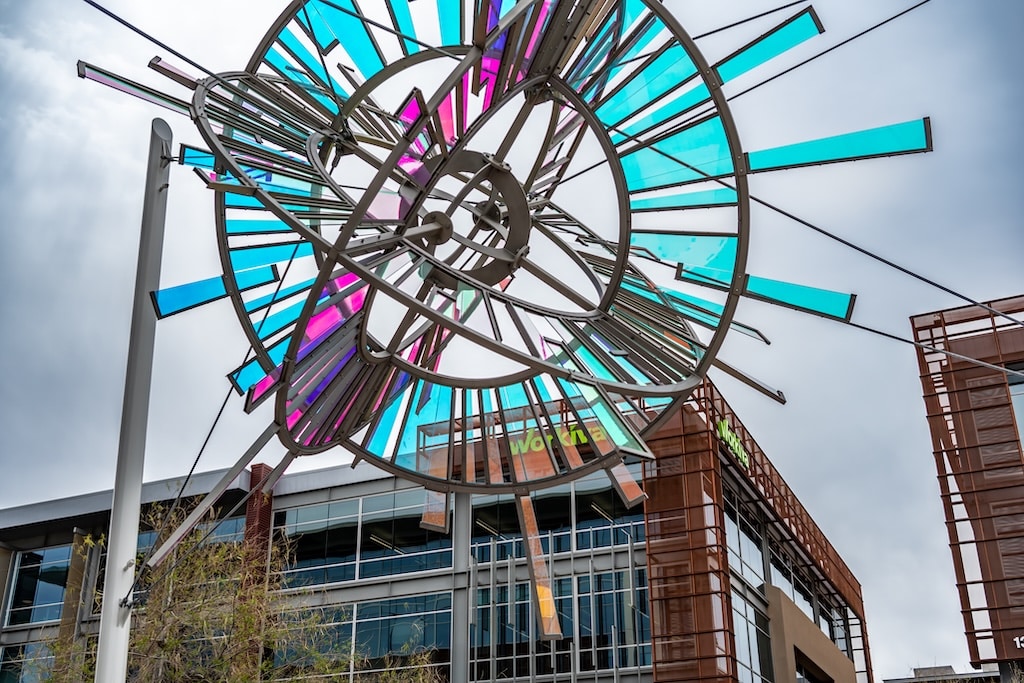
Dichroic Glass Sunburst Sculpture – Scottsdale, AZ
The transition of dichroic tech into the art world, happened in the 1970s when NASA developed the “Spinoff Program”.
It was then, that an aerospace engineer named Murray Schwartz – who worked for a NASA contractor (Wallin Optical Systems) in the 1960s – would leave the industry to apply this technology to art.
In the early 1970s, NASA officially documented Murray’s business “KROMA” as a successful reapplication of space technology for public use – which is what the “Spinoff Program” was all about.
It was during this time that Murray was incorporating rejected aerospace mirrors into his sun catchers and mobiles. He would find these colorful and vibrant mirrors in the dumpsters behind the vacuum deposition facilities.
At the same time, a man named Jerry Sandberg (who was a world class engineer and third-generation jeweler) was working for GM Vacuum Coating Laboratory in Newport Beach, California where they produced dichroic mirrors for the aerospace and scientific communities.
The story goes, that Jerry happened to notice Murray digging through the company’s dumpster looking for the rejected dichroic mirrors.
When Jerry met Murray – and saw what Murray was creating with the mirrors – Jerry became intrigued with the notion of creating glass for the art glass industry.
Jerry and Murray teamed up to create the first three dichroic glass colors: Cyan-Red, Magenta-Green, and Yellow-Blue.
By the mid 1990s Jerry was being approached by hundreds of artists for a reliable supply of this magnificent glass.
In 1996, Jerry and his wife Nona formed “Coatings By Sandberg, Inc.” where they still manufacture the high quality dichroic art glass that you find in art supply stores that specialize in glass.
1990s – Today:
Although the word “dichroic” means two colors, modern dichroic glass can have 3 or more colors AND they come in different patterns and textures.
It’s been used for building facades, lighting, stained glass projects, jewelry, and many other items.
Here’s an example of its color changing abilities as evidenced by one of the pendants we created using dichroic glass in our studio:
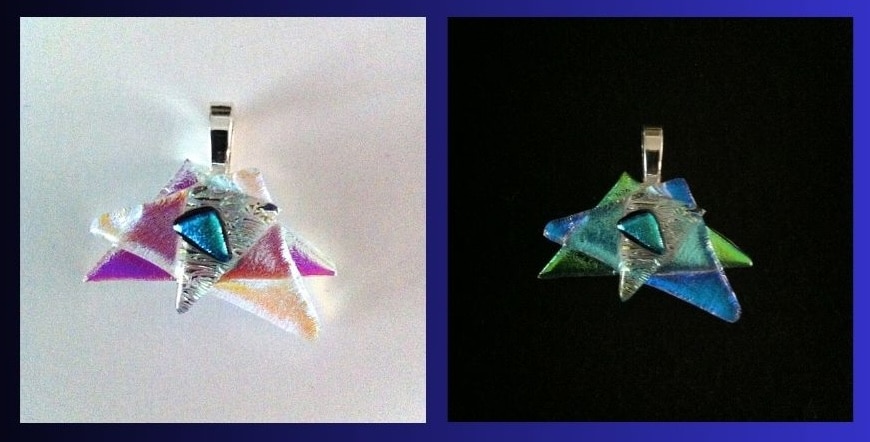
Photos: Pendant from The Purple Galaxy studio
So…
I hope you liked our little walk through dichroic history. Unquestionably dichroic glass is one of the most beautiful types of glass out there.
Each piece has a life of its own. It shares it’s secret brilliance through a dance of light and color. It reflects negativity away while bringing beauty into our lives.
Shine on like the Star that you are!


Views: 47