
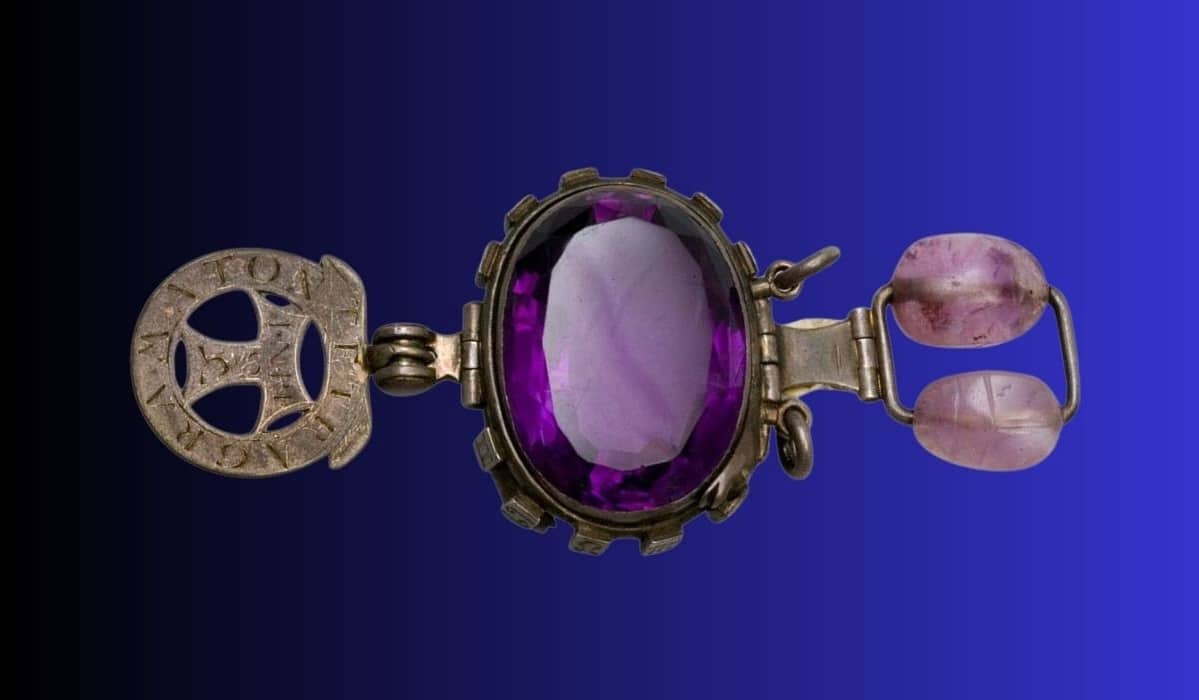
Do you Believe a Jewel Could be Cursed?
This is the strange, and spooky, story of the Delhi Purple Sapphire — a gemstone that isn’t even a sapphire
When I first came across the story of the Delhi Purple Sapphire, I just wanted to write a quick little post about it. A fun fact, a paragraph or two, maybe a pretty photo.
However, the more I learned about it, the more I had to know. Because this story has everything — a looted temple, a Victorian scientist losing his mind, a canal, seven nested boxes, a handwritten curse letter, and a twist ending that made me actually laugh out loud.
So settle in. This one’s worth it.
First off, it’s Not a Sapphire
The stone sitting in a display case at the Natural History Museum in London is officially called the Delhi Purple Sapphire. It looks important. It sounds important. And for a long time, everyone just… took the name at face value.
It’s an amethyst. A beautiful one, set in an elaborate silver setting with a snake-shaped bezel wrapping around the stone. The bezel surrounding the amethyst also has silver rectangular pieces engraved with astrological glyphs on it. Additionally, two amethyst scarab beetles are attached at one end for good measure. Whoever named it either made a mistake or, as we’ll get to, may have had reasons of their own.
The Legend Begins in 1857
Legend has it, that the stone originally came from India in 1857. The country is in the middle of the Indian Rebellion — a massive, violent uprising against British colonial rule. During the chaos, a British cavalry officer named Colonel W. Ferris allegedly walked out of a temple in Kanpur dedicated to the Hindu god Indra carrying a purple gemstone that didn’t belong to him.
He brought it back to England. And according to the letter that would eventually surface decades later, almost immediately things started going wrong. Financial ruin. Health problems. His family was plagued by misfortune. He passed it to his son. Same story. Eventually the son gave it away to a man named Edward Heron-Allen, probably with enormous relief.
“This stone is trebly accursed and stained with the blood and dishonor of everyone who has ever owned it.” — Edward Heron-Allen, 1904
Enter the Rational Man who Lost his Reason
Here’s what I love about Edward Heron-Allen. He was not the kind of person who believed in curses. He was a scientist, a writer, a lawyer, a violinist, a scholar who spoke multiple languages. He was exactly the kind of person who would raise an eyebrow at anyone who told him a rock could ruin your life.
He accepted the stone in 1890. And things started going sideways almost immediately.
He gave it to a friend. That friend was, in his words, “overwhelmed by every possible disaster.” The friend gave it back. He gave it to a singer. She lost her voice and never sang again. She gave it back.
So this brilliant, skeptical man of science walked to the Regent’s Canal in London and threw it in.
Three months later, a river dredger pulled it out of the water. A dealer bought it. And then tracked down Heron-Allen and gave it back to him.
At this point Heron-Allen did something I find completely understandable: he gave up trying to fight it and went full protective ritual mode. He had the stone put in that silver snake setting. He attached zodiac symbols and scarab beetles. And then he locked it inside seven nested boxes, each sealed, surrounded by protective charms, and deposited the whole thing in a bank vault with strict instructions: do not open this until at least three years after my death.
He also wrote a letter. A long, dramatic, genuinely wonderful letter explaining everything and warning whoever found it that the stone was, and I quote, “trebly accursed.”
The Museum, the Drawer, and the Storms
Heron-Allen died in 1943. His daughter donated the sealed package to the Natural History Museum almost immediately — sensibly not waiting the three years. And then it sat, forgotten, in a storage drawer for nearly thirty years.
Until 1972, when a curator named Peter Tandy found a strange sealed box, opened it, found the amethyst in its elaborate setting… and the letter.
The museum put it on display. And here’s where the story gets one final, delicious twist.
In 2004, a museum member transported the stone to an event. He drove through what he described as the most ferocious storm he’d ever seen. He got sick shortly after. In 2007, when the stone went on full public display, the curator who drove it back reported the same thing — an extraordinary storm, lightning everywhere, the whole way home.
Coincidence? Almost certainly. But still.
Here’s the Part that Made me Wonder
Some researchers think Heron-Allen made the whole curse story up. Why? Because right around the same time he acquired the stone, he published a short story called — wait for it — “The Purple Sapphire.” About a cursed gemstone from India.
One museum historian has suggested he may have invented the backstory to promote his fiction, had the silver setting made specially, and chose an amethyst because a real sapphire of that size would have cost too much.
So was it a genuine ancient curse from a looted Hindu temple? Or was it one of the most committed literary publicity stunts in Victorian history?
Honestly? I kind of love it either way.
You Can Still See it Today
The Delhi Purple Sapphire (amethyst), is on permanent display in the Vault gallery at the Natural History Museum in London, sitting in its silver snake setting alongside Heron-Allen’s letters. You can go see it. The museum even displays the warning letter right next to it.
If this story has you as obsessed with purple gemstones as I am, stay tuned — I’m working on a series of the most famous purple jewels in history, each with their own wild myths and legends. It’s going to be a good one.
Until Next Time… Stay Purple. 💜
What’s New
-
Sale!

Vancasso 24 Piece Stoneware Dinnerware Service for 8
Original price was: $159.99.$159.00Current price is: $159.00. -
Sale!

Purple 9ft Outdoor Patio Umbrella by Jearey
Original price was: $55.99.$49.00Current price is: $49.00. -

Ultra Soft, Extra Large, 3 Piece Dark Purple Bathroom Rug Set. Eggplant
$65.00 -
Sale!

Purple Plush Queen Size Sherpa Blanket
Original price was: $52.99.$39.00Current price is: $39.00.
Views: 90